Grab the pole from shovel and use it to modify the guitar. Do you think this is impossible? In Russia everything is possible.
Here you can see that bass guitar is being reworked. It's not entirely clear why - scale length remains the same, but there is no truss rod. Distortion can be put on bass. Nevertheless, pole from shovel excellently enters the docking area, which is very encouraging to author of video.
Actually, this can be played and sometimes even music is produced. This is suitable for djent and progressive music. Well, we wish the author success in working with this device.

Showing posts with label bass. Show all posts
Showing posts with label bass. Show all posts
June 13, 2018
February 18, 2018
9 string guitar vs bass
Previous blog entry made me ask myself another similar question: why not just take a bass instead of a 9 string guitar? This video perfectly shows the difference.
Great job. You can see that guitarist and the bassist are playing in unison. But sound of instruments is different even if you apply the same tone.
On video uses guitar Schecter Hellraiser C9 and some bass (they are not much different). Scale length of this guitar is 28 inches (baritone), scale length of bass is 35.5 inches. This implies using a different strings set. That is, for these reasons, oscillations (and, as a consequence, the timbral coloring) will be very different. Also pickups construction is slightly different. Therefore, pedals or processors always indicate for which instrument they are intended. I even saw a pedal specifically for extended range guitars or with a dropped tuning (Ibanez 7th heaven).
Well, this is not a review, so we'll finish this.
Great job. You can see that guitarist and the bassist are playing in unison. But sound of instruments is different even if you apply the same tone.
On video uses guitar Schecter Hellraiser C9 and some bass (they are not much different). Scale length of this guitar is 28 inches (baritone), scale length of bass is 35.5 inches. This implies using a different strings set. That is, for these reasons, oscillations (and, as a consequence, the timbral coloring) will be very different. Also pickups construction is slightly different. Therefore, pedals or processors always indicate for which instrument they are intended. I even saw a pedal specifically for extended range guitars or with a dropped tuning (Ibanez 7th heaven).
Well, this is not a review, so we'll finish this.

December 10, 2017
Virtual bass: Fodera Yinyang VS Scarbee pre-bass
I really love playing guitar, but I don't have other instruments. Therefore, writing rhythm section for a long time was a big problem. The solution was the use of VST plug-ins in sequencer. Tried several pieces and decided to compare the most interesting. Today we considering two virtual instruments. First is Fodera Yinyang from Ample Sound. Second is Scarbee pre-bass from Native Instruments.
Fodera Yinyang
 Let's imagine this situation: we will give two different people headphones with an ideally accurate frequency response and ask for opinion. The first is usual average people, which does't see any reason to pay for headphones more than 2 bucks. The second is a person who has good hearing and extensive knowledge about sound (musician, sound engineer, etc.). I think you can imagine what they will say.
Approximately the same thing here. It would seem, four strings, standard tuning, two pickups, well, what can you think of yet? However, from very beginning, you understand that this is something unusual. Then we googled the title of this instrument and see that the same device uses Victor Wooten. A specialist of this level can't take bullshit.
Advantages:
Disadvantages:
Scarbee pre-bass
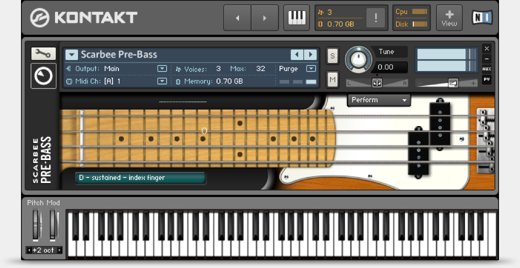
Sound of legendary Fender Precision Bass '72 is now available in VST format. Further description is pointless: this instrument has been showing excellent sound for decades. Users are given a clean sound. Absolutely clean - sound was recorded in a line.
Advantages:
Disadvantages:
Here are such interesting opposites.
Fodera Yinyang
Approximately the same thing here. It would seem, four strings, standard tuning, two pickups, well, what can you think of yet? However, from very beginning, you understand that this is something unusual. Then we googled the title of this instrument and see that the same device uses Victor Wooten. A specialist of this level can't take bullshit.
Advantages:
- Suitable for soloing and non-standard ideas. Perfect sounding of hammer-on/pull-off, natural harmonics, slap, tapping and scales. Very soft glissando.
- There are many different instruments for forming a timbre. There is a distortion here - you can feel like Cliff Burton.
- You can choose between active and passive electronics.
- Sound is completely processed - there are no unnecessary resonances, noises.
- Significantly shortens running time without losing sound quality - many elements are automated. Just write or import midi file into track, select elements of timbre and enjoy result.
- Also here is the function Riffer, which makes it easy to compose parts or generate random.
- Interface is well thought out - very convenient arrangement of elements.
Disadvantages:
- Apply this instrument to a usual rhythm section - it's like digging a garden in a tuxedo. Yes, this plugin has a very interesting sound, but to pull the fourth string under the bass drum is better to choose something else.
- It requires a lot of CPU resources.
- Automation erases some shades. For example, here is a strange (for real instrument) algorithm for switching strings, but it can't be done manually.
Scarbee pre-bass
Sound of legendary Fender Precision Bass '72 is now available in VST format. Further description is pointless: this instrument has been showing excellent sound for decades. Users are given a clean sound. Absolutely clean - sound was recorded in a line.
Advantages:
- A raw sound that can be finely tuned in accordance with your artistic task.
- Extensive possibilities: suitable for soloing and rhythm section. Everything depends only on your artistic task, your knowledge, your imagination and the resources of your cpu.
- Strings can be switched manually. This is very important: one note can be played in different ways, but usually only one sound is recorded.
- Composer not only hears, but also sees the process. Below the neck there is a text footnote that displays the last note and the last used articulation.
- Minimum interface elements is only what is needed.
Disadvantages:
- Bad suitable for non-standard ideas.
- The need for fine-tuning sound is a lot of time spent. Add an cabinet emulator, remove resonances and noise. Not everyone likes this. And also the whole process of processing can take much more CPU resources than previous plug-in.
- Do you think that simplicity is a small amount of CPU resources? This is not always true. This plugin is just part of one large Kontakt platform, which is very demanding on CPU.
Here are such interesting opposites.
October 18, 2017
Virtual guitars: Ample Metal Eclipse vs RealEight
Technological progress does't stand still and it gives composers more opportunities. First, recording studio became virtual. Now instruments have become virtual. No, not only synthesizers, but also high-grade guitar / bass samplers, sound of which almost does't differ from real instruments.
Today I want to compare two virtual guitars. First is Ample Metal Eclipse from Ample Sound. Sound of real ESP Eclipse guitar is now in a small application. Guitar has a Drop C tuning and it's very suitable for modern sound. Second is RealEight from Musiclab. It's hard to say what kind of guitar is this - fashion for lowered tuning gave a start to production of a large numbers extended range guitars.
So, let's begin.
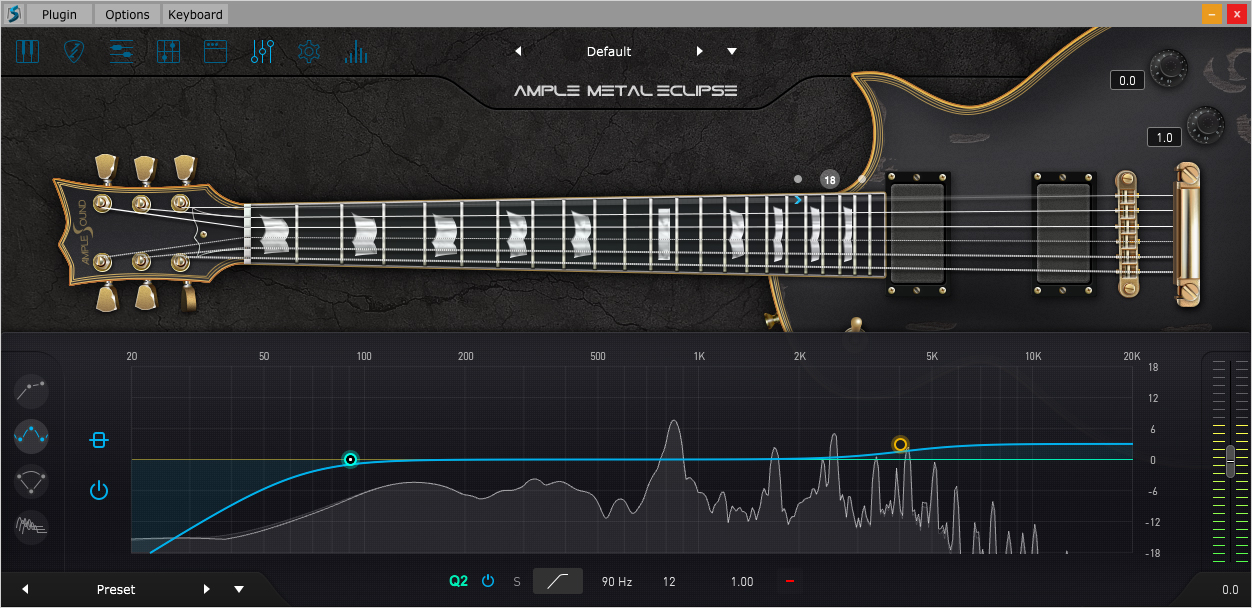 Ample Metal Eclipse
Black body, black fretboard, black pickups and only strings, inlay, frets and machine heads glint with evil glint. It looks very cool.
Advantages:
Disadvantages:
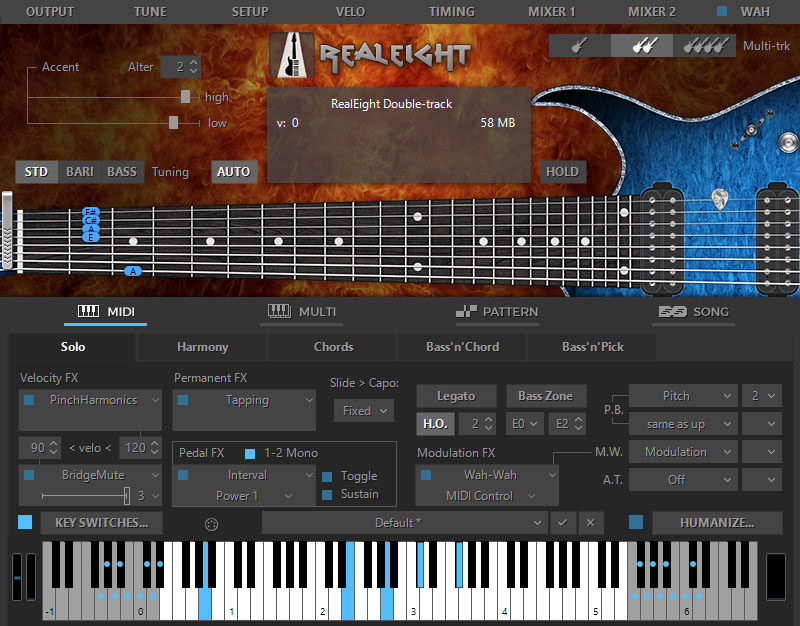 RealEight
At first it's difficult to focus on one thing: there are not only many strings, but also many elements on control panel. In a few minutes, poking at random begins to understand more.
Advantages:
Disadvantages:
It turns out these are interesting opposites.
Today I want to compare two virtual guitars. First is Ample Metal Eclipse from Ample Sound. Sound of real ESP Eclipse guitar is now in a small application. Guitar has a Drop C tuning and it's very suitable for modern sound. Second is RealEight from Musiclab. It's hard to say what kind of guitar is this - fashion for lowered tuning gave a start to production of a large numbers extended range guitars.
So, let's begin.
Black body, black fretboard, black pickups and only strings, inlay, frets and machine heads glint with evil glint. It looks very cool.
Advantages:
- And it sounds very cool. Very high quality, deep, rich sound.
- Drop C Tuning. The usual six-string, but it fits well with modern sound, where an extended range is required. Also, this is a rarity for this company - usually this is standard E or Drop D.
- Ease. You don't need much knowledge. A few clicks - and guitar part is ready.
- Humanization. You can make a guitar sound very close to what you get when playing a real guitarist on a real guitar. But unlike the next example, this happens automatically.
- Several options for writing guitar parts. In addition to standard "Strummer" you can import guitar tabs in GP format. Also there is an excellent function called Riffer. This feature makes it easy to create riffs. It's also possible to generate a random riff: you only need to select measure size, key and chord.
- You can create a timbre. In "FX" tab there are most popular pedals: compressor, overdrive, equalizer, chorus, phaser, delay, reverb and wah-wah.
Disadvantages:
- Despite the long development, plugin is still unstable. Can refuse to work at any time.
- Plugin requires a lot of CPU resources. That is, you need a very powerful computer.
- He sees only Cubase / Nuendo and only 8 and higher versions.
RealEightAt first it's difficult to focus on one thing: there are not only many strings, but also many elements on control panel. In a few minutes, poking at random begins to understand more.
Advantages:
- Installing the plugin, you can immediately two instruments: guitar and bass.
- Wide range. There are additional strings - seventh (B1) and eighth (F#1). Bass is an octave lower.
- Thin settings. You can form almost any sound. Probably, for this reason, this was called "Real."
- Requires little CPU. Suitable for weak computers.
- Any sequencer sees it.
Disadvantages:
- Sound can't be called qualitative. Usual Chinese eight-string for 150-200 USD.
- Sound has a very turbid attack.
- Requires a lot of knowledge. At first it may seem that it's intended for beginners who have a weak computer. But this impression is deceptive. This is very difficult to understand.
- Difficulties don't end there. This plugin sees only standard patterns. Non-standard patterns with this - it's a real misery. Importing custom MIDI files to working directory does't give anything.
It turns out these are interesting opposites.
Subscribe to:
Posts (Atom)